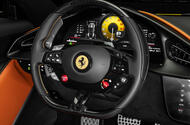
Haptics went against "our objective of eyes on the road, hands on the wheel", says Ferrari commercial boss
Ferrari says it made a mistake by replacing physical buttons with haptic controls on its steering wheels, and it will reverse the decision across its range.
The move begins with the Amalfi, which is also fitted with the traditional start/stop button that owners wanted to return. The haptic tech was first introduced in the SF90 hypercar and is also partially used in the new F80.
Commercial boss Enrico Galliera said the tech was introduced when trying to recreate the speed of interaction experienced while using a phone. He said: “When we decided to create the SF90, the brief was to have the most performing Ferrari ever. We wanted to establish a distance versus our competitor. To achieve that, we put in all the most advanced available technologies.
“So, we pushed our team to redesign the digital interaction. When we started this job, the idea was, when we interact with our phone is a touch, and the more you use the touch button the more you are quick in the execution, which, in principle, is absolutely true. So all the development was done following this path and these rules.Â
“The final execution was, I think, extremely innovative, but we didn't consider then when you use it, you're also driving and the end result [goes against] our objective of eyes on the road, hands on the steering wheel.â€
He added: “So this is the why we did it, because we wanted to have the most advanced system, and we realise, honestly, that it was probably too advanced and not 100% perfect for the use that is done in the car. So this became clear and it was feedback that we received very loudly from our clients.
“We believe that still the digital interaction has an advantage, but it should be blended in a way that the most used button should be physical, and some of them, like the start/stop, which are iconic, representing part of the history, should be there for this reason.
Galliera confirmed that, following the Amalfi, this new set-up “will be deployed in every new launch we put in the market,†adding: “We will rebalance the ratio between digital buttons and physical buttons.â€