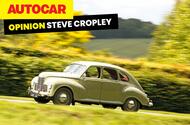
Cropley's first memories of the motor car were developed in the back seat of this unusual 1950s classic
The Jowett Javelin was one of the first cars in which I was driven as a very young kid – the third car, I think. It sticks in the memory because one of my parents’ friends had one and was very proud of it, to the point of bothering to explain its finer points to a seven-year-old.
Unusually for the time, this woman loved cars and knew a lot about them: she was the person who first explained to me what was different about a flat-four engine (the Javelin had an aluminium 1.5-litre unit mounted ahead of the front wheels, driving the rears) compared with the inline fours and sixes contemporary cars had.
She also talked about aerodynamics – this car, she reckoned, benefited very much from what we had learned about ‘streamlining’ from the wartime design of Spitfires and Hurricanes.
She even explained torsion bar suspension (the Javelin had it at both ends) and how certain types of steel, made into bars, could act like springs if you twisted them.
My best memory is of the way she drove the car. In its day the Javelin (made between 1947 and 1953) was a lively performer, although 0-50mph in 13-odd seconds may no longer set your trousers on fire. But this keen owner was aware that a Javelin had competed successfully in the Monte Carlo Rally, and she took that as licence to chuck it about a bit with us kids in the back.
We’re talking late 1950s here, so my impressions can’t be relied on, but I definitely remember this Javelin as being faster and nimbler than my old man’s battered Ford Consul.
Weirdly, my Javelin consciousness has stayed with me, although I’ve never driven one. What I still love is the optimism and ambition that emerged in British car and motorcycle design from the technological advances of the war years.
The twin British systemic failures, as we know, were in series production and marketing: the UK started the post-war era with the world’s biggest car export market but soon lost it to the Americans and Japanese, who knew how to make cars profitably and have them hang together.
The Jowett was killed off by cost, gearbox failures, crankshaft breakages and the company’s general inability to please the customer. Even my parents’ family friend finished up in a Holden like everyone else.
But I still look at the Javelin’s sleek Gerald Palmer shape, admire its spacious cabin and remember how it responded to enthusiastic steering inputs. It was an era whose star cars are now largely forgotten or glossed over, but the Javelin deserves its little place in the ranks of ambitious cars, even if it never truly made it.